Skip to content

Magento Upgrades & Technical Debt
1. Introduction
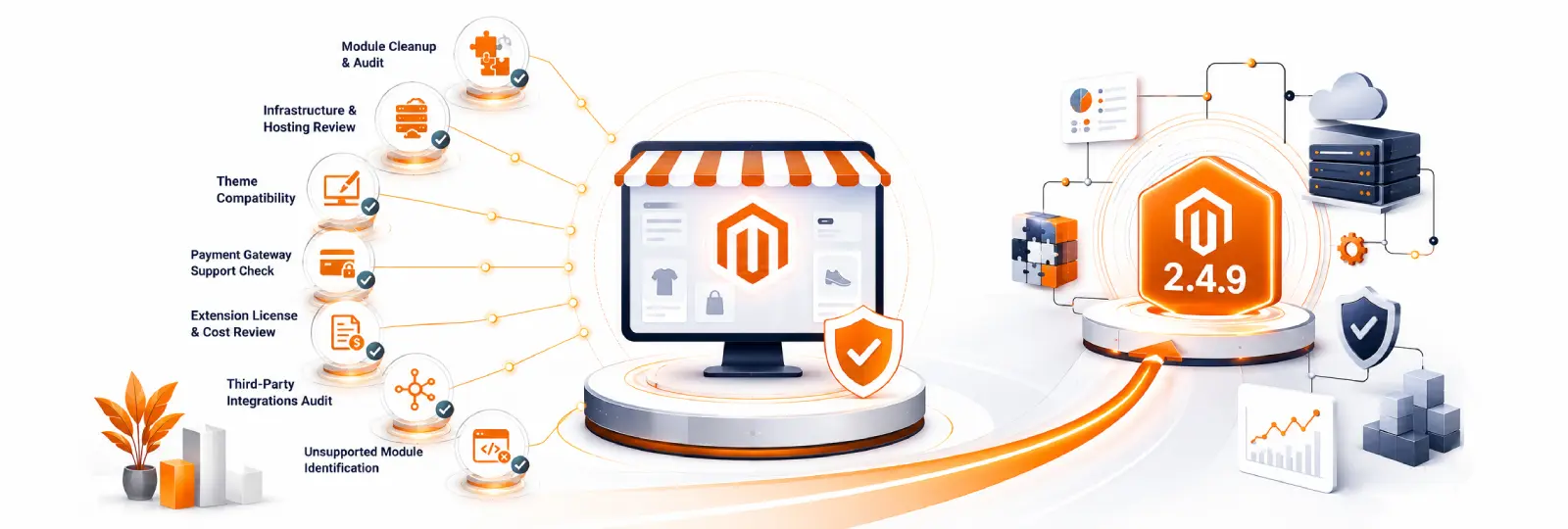
Magento upgrades are rarely just version updates.
You plan for a minor upgrade… and end up debugging for weeks.
It is not the version change that hurts, it’s what your codebase has become over time.
Technical debt doesn’t show up during development.
It shows up when you try to move forward.
2. The Problem
Most Magento stores don’t “break” suddenly they slowly become upgrade-resistant.
This happens because of common shortcuts:
- Quick fixes to meet deadlines
- Direct core file modifications
- Improper module structure
- Ignoring Magento architecture standards
Everything works fine initially.
But during an upgrade, these shortcuts turn into blockers.
What worked fast yesterday becomes expensive today.
3. Why It Happens
Management Flaws
- No Magento architect involved in decisions
- PHP developers implementing without Magento standards
- No pre-upgrade audit or code review
Result: Decisions optimize speed, not sustainability
Technical Reasons
Magento evolves with every release:
- Deprecated methods get removed
- Service contracts change
- Dependency versions shift
If your code is tightly coupled, it cannot adapt.
Example: Tight Coupling (Wrong Approach)
$product = $this->_objectManager->create('Magento\Catalog\Model\Product');
$product->load($id);
$product->setName('New Name');
$product->save();
Problems:
- Uses Object Manager directly ❌
- Uses deprecated load() / save() ❌
- Breaks during upgrades ❌
Correct Approach (Service Contract)
public function __construct(
   \Magento\Catalog\Api\ProductRepositoryInterface $productRepository
)

$product = $this->productRepository->getById($id);
$product->setName('New Name');
$this->productRepository->save($product);
Benefits:
- Upgrade-safe ✔
- API-based ✔
- Decoupled ✔
This is the difference between stable upgrades and painful ones.
4. Cost Impact
Technical debt directly affects your upgrade budget:
- Upgrade timelines stretch from days → weeks
- More developers needed for debugging
- QA effort increases significantly
- Higher production risk
A simple upgrade becomes a full-scale project.
5. Key Insight
Magento upgrades don’t fail because Magento is complex.
They fail because your code is not aligned with Magento’s architecture.
Upgrade difficulty = Reflection of your code quality
6. Real-World Scenario
Situation
A Magento 2.3 store planned an upgrade to 2.4.
What Went Wrong
- Custom modules used direct model calls
- Deprecated methods caused fatal errors
- Third-party modules conflicted
Result
- Upgrade delayed by 3 weeks
- Development cost increased by 40%
- Multiple hotfixes post-release
Root cause: Accumulated technical debt
7. How to Control Technical Debt
1. Use Service Contracts Everywhere
Avoid direct model usage
2. Follow Dependency Injection Properly
// Wrong:
$objectManager = \Magento\Framework\App\ObjectManager::getInstance();


// Correct:
public function __construct(
   \Magento\Framework\App\Config\ScopeConfigInterface $scopeConfig
)
3. Avoid Core Overrides
Bad:
- Overriding core classes directly
Better:
- Use plugins (interceptors)
<type name="Magento\Catalog\Model\Product"><plugin name="custom_plugin" type="Vendor\Module\Plugin\ProductPlugin"/><type/>
4. Keep Modules Loosely Coupled
- Avoid hard dependencies
- Use interfaces instead of concrete classes
5. Regular Refactoring
- Clean deprecated code
- Remove unused modules
- Keep dependencies updated
8. Quick Checklist
Use this before any upgrade:
- No direct load() / save() usage
- No Object Manager in business logic
- No core file modifications
- All modules follow Magento coding standards
- Dependencies are updated
- Code reviewed for upgrade compatibility
9. Final Takeaway
Magento upgrades become expensive when technical debt is ignored.
If your codebase is clean, upgrades are predictable.
If not, every upgrade becomes a risk.
You don’t fix upgrade issues during upgrade you fix them during development.