Skip to content

Table of Contents
-
- Start With One Core Principle Every Month
- Don’t touch what Must Be Retained
- Evaluate What Can Be Enhanced
- Identify What Should Be Replaced
- Apply the Same 4-Question Filter Consistently
- Be Clear About Where AI Should NOT Be Forced
- Focus on Cost Optimization Through Cleanup
- Reduce What You Carry Into the Upgrade
- Keep the Focus on Efficiency, Not Just Compatibility
- Final Thought
Magento Modules in the AI Era: What to Retain, Replace, or Rethink (During Upgrade)
What Steps to Start Taking on a Monthly Basis ( If an Upgrade Is Planned in next six months )
Most Magento upgrades focus only on compatibility.
Treat it as a continuous process where every month is used to improve efficiency, validate modules, and make smarter decisions.
Because one thing is clear, AI has changed one thing
Not every module deserves to survive the upgrade.
So the monthly effort is not about doing more work. It’s about doing the right filtering, consistently.
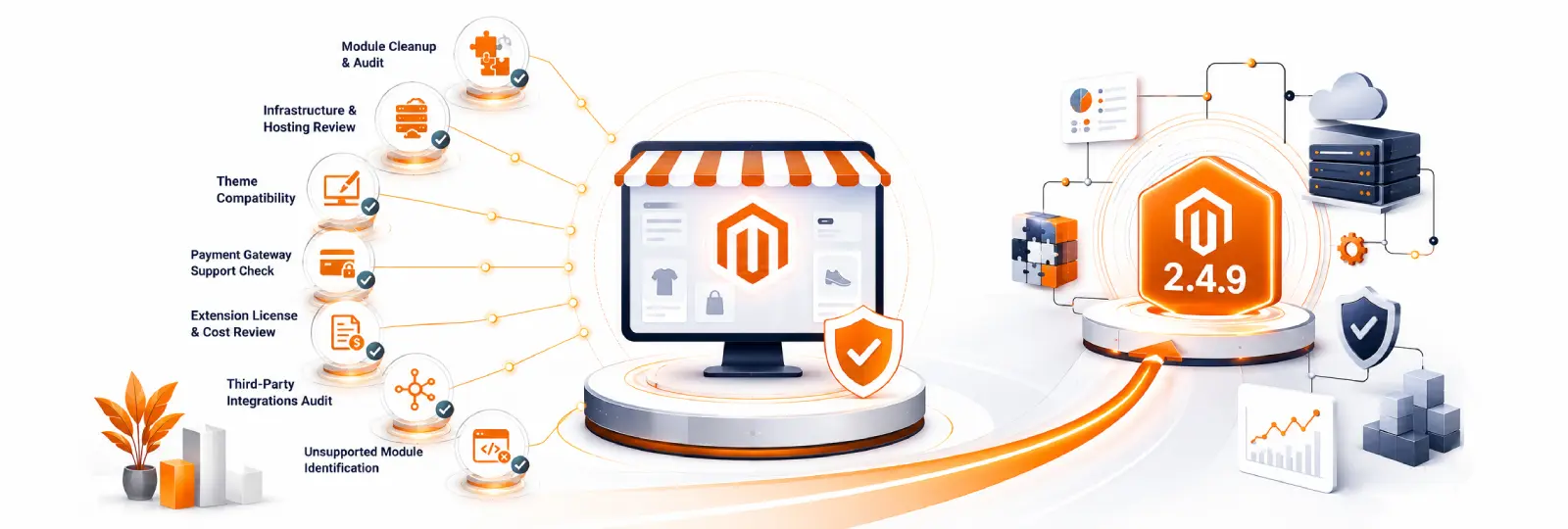
1. Start With One Core Principle Every Month: Don’t Migrate Everything
The biggest mistake in upgrades is carrying forward everything “as is.”
So each month, the actively question:
- Do we really need this module?
- Is it still relevant?
- Is it solving a real problem today?
Because in most stores:
- 20–30% of modules are outdated or unused
- Some features are already available natively
- Others exist only because they were needed at some point in the past
This mindset alone changes how upgrades are approached.
Instead of preparing for migration, you start preparing for elimination and simplification within a Magento AI Upgrade Strategy framework.
2. Don’t touch what Must Be Retained (Non-Negotiable Layer)
Every month, make sure there is complete clarity on what should never be touched.
These are the modules where:
- Accuracy is critical
- Errors are expensive
- Stability matters more than innovation
This includes:
- Payment, tax, and compliance modules
- Shipping and inventory systems
- ERP and core integrations
- Order lifecycle flows
These are not areas to experiment with or optimize aggressively.
The goal here is simple: Protect what must remain stable.
This clarity also prevents wasting time trying to “improve” things that are already doing exactly what they should.
3. Evaluate What Can Be Enhanced
Once the stable layer is clear, the next step every month is to look at modules that are not broken but limited.
Key areas:
- Site search
- Recommendations
- Customer segmentation
Here, the thinking shifts from:
- “Should we remove this?”
to - “Can this become smarter?”
Examples of that shift:
- Search becoming more semantic instead of keyword-based
- Recommendations going beyond basic behavior
- Segmentation moving from static rules to predictive insights
This is a gradual process.
You are not implementing everything at once.
You are identifying where intelligence can be layered over time.
4. Identify What Should Be Replaced ( High AI ROI Areas )
Every month, focus on modules that clearly fall into one category:
High effort, repetitive, rule-based work.
These are the easiest decisions.
Examples:
- Rule-based chatbots
- Manual catalog enrichment
- Static SEO and content workflows
These systems usually:
- Require continuous manual input
- Follow predictable patterns
- Add operational overhead
This is where AI has the highest return.
So instead of maintaining or upgrading these modules, the focus becomes:
Should this even exist in its current form?
In many cases, the answer is no.
5. Apply the Same 4-Question Filter Consistently
Rather than doing a one-time evaluation, apply your filter every month across different modules.
- Is it rule-based or context-driven?
- Does it require strict accuracy?
- Does it involve high manual effort ( admin activity )?
This keeps decision-making simple and consistent.
It removes guesswork and avoids decisions based on:
- Habit
- Past investments
- “We’ve always used this” thinking
Over time, this filter naturally separates:
- What should stay
- What should evolve
- What should be removed
6. Be Clear About Where AI Should NOT Be Forced
A common mistake during modernization is overusing AI.
So every month, validate boundaries:
Do not push AI into:
- Checkout and payment flows
- Tax and compliance logic
- Core integrations
Because here:
- Risk is higher than reward
- Precision is non-negotiable
- Stability matters more than intelligence
This ensures that while the system becomes smarter, it does not become unpredictable.
7. Focus on Cost Optimization Through Cleanup
Each monthly cycle should directly contribute to cost reduction.
Not through cutting corners, but by:
- Removing unused modules
- Eliminating duplicate functionality
- Reducing unnecessary complexity
This leads to:
- Lower upgrade effort
- Fewer potential bugs
- Better performance
Instead of treating cost optimization as a separate goal, it becomes a natural outcome of a Magento AI Upgrade Strategy.
8. Reduce What You Carry Into the Upgrade
The biggest advantage of this monthly approach is this:
You are not waiting until the upgrade to clean things up.
You are doing it continuously.
So by the time the upgrade happens:
- Unused modules are already gone
- Redundant systems are removed
- Only meaningful functionality remains
This directly impacts:
- Upgrade speed
- Stability
- Long-term maintainability
9. Keep the Focus on Efficiency, Not Just Compatibility
Most upgrades stop at: “Will this module work with the new version?”
But every month, the better question is: “Should this module exist at all?”
That’s the shift your blog emphasizes. And that is what changes outcomes.
Final Thought
If this process is followed consistently each month, the upgrade stops being a heavy, risky activity.
It becomes the final step in a system that is already:
- Cleaner
- Smarter
- More efficient
Because in the end:
A Magento upgrade is not just about making things compatible. It’s about making sure only the right things move forward.
And that’s how you replace inefficiency with intelligence.