Skip to content

Table of Contents
- Dependency Injection Is Not Optional and Upgrades Will Prove It
- Why Dependency Injection Is Central to Magento 2
- The Anti-Pattern That Quietly Breaks Upgrades
- Service Contracts: The Stability Layer Between Your Code and the Platform
- How DI Directly Reduces Debugging Cost
- The Step Most Teams Skip: Regular Code Audits
Dependency Injection Is Not Optional and Upgrades Will Prove It
Most Magento upgrade failures are not a platform problem. They are an architecture problem one that was written months or years before the upgrade began.
Every time a Magento upgrade derails a team, someone points at the platform. But in most cases, the platform is not the problem. The shortcuts taken when writing the original code are.
Why Dependency Injection Is Central to Magento 2
Magento 2 was architected around Dependency Injection from the ground up. It is not a best practice bolted on after the fact it is the mechanism through which the entire framework manages objects, services, and configuration. Treating Magento Dependency Injection as optional means operating against the grain of the system itself.
When DI is implemented correctly across a codebase, it delivers several structural advantages that compound over time:
- ✓Core files are never modified, so platform updates apply cleanly without conflict.
- ✓Customizations remain isolated and scoped, making them straightforward to identify, test, and update.
- ✓Code is built to survive version changes because it depends on contracts, not on internal implementation details.
- ✓Long-term maintenance cost – the Total Cost of Ownership – stays predictable and controlled.
The Anti-Pattern That Quietly Breaks Upgrades
The most common way DI gets bypassed is through direct use of ObjectManager::getInstance(). It feels convenient in the moment. It resolves the immediate problem. And it introduces fragility that only surfaces later usually at the worst possible time.
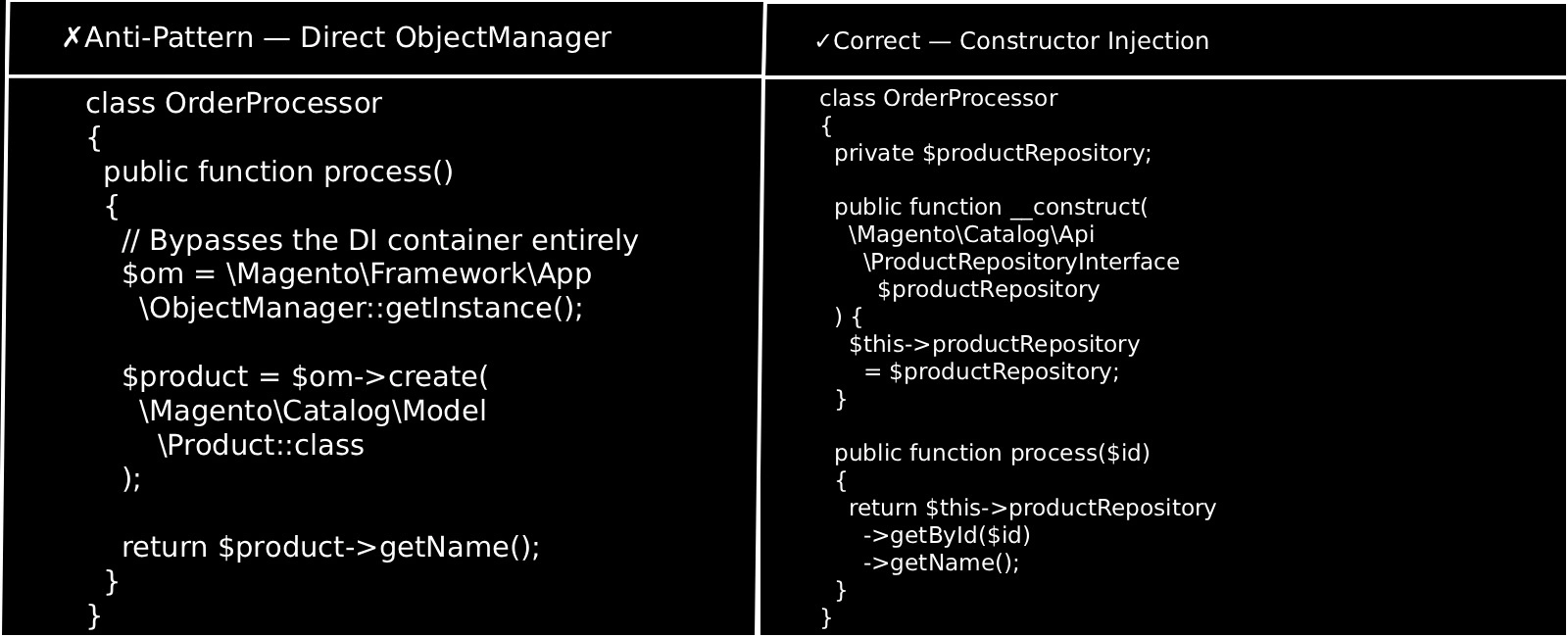
The difference is not just stylistic. The first approach creates hidden, untracked dependencies on concrete internal classes. When Magento changes how those classes are constructed or what they depend on which happens across major versions the code breaks silently and fails at runtime. There is no compile-time warning, no clear error trail, just a runtime failure that requires reactive debugging.
The second approach declares its dependencies openly through the constructor. The framework manages object creation. If something changes at the framework level, the DI container surfaces the issue during dependency graph compilation not buried in a production runtime error.
Why It MattersUsing
ObjectManager::getInstance() severs the DI chain. It makes the code impossible to unit test, invisible to the framework’s object lifecycle management, and highly fragile against version changes. It is the single most common cause of upgrade-related code failures in Magento projects.
Service Contracts: The Stability Layer Between Your Code and the Platform
One of the key reasons the constructor injection approach holds up across upgrades is that it depends on a service contract an interface rather than a concrete model class. Magento’s service contracts are stable public APIs. Magento commits to maintaining their signatures across versions.
Concrete model classes like Magento\Catalog\Model\Product carry no such guarantee. Their internal constructors, properties, and dependencies can and do change between versions. Code that relies on them directly inherits all of that instability.
Depending on an interface is a bet that the contract will hold. Depending on a concrete class is a bet that the internal implementation will never change. One of those bets is much safer than the other and aligns with Magento Dependency Injection principles.
How DI Directly Reduces Debugging Cost
When dependencies are declared through constructors and wired through DI configuration, the codebase becomes navigable. You can follow the dependency tree, understand what each class requires, and trace failures to their actual source.
When ObjectManager is scattered across the codebase, dependencies are hidden. Debugging means searching for where objects are being created, not tracing a clear structure. The time cost of this compounds every debug session, every patch, every upgrade attempt takes longer than it should.
This is why DI is as much a cost management tool as it is an architectural principle. Teams that follow Magento Dependency Injection consistently see:
 Significantly less time spent debugging upgrade-related regressions.
- Fewer surprise failures appearing in production after a version change.
- Lower ongoing maintenance effort because the codebase is structured and traceable.
 Significantly less time spent debugging upgrade-related regressions.
The Step Most Teams Skip: Regular Code Audits
Following DI principles going forward is necessary. But if a codebase already has years of accumulated shortcuts, those need to be identified and addressed not discovered during an upgrade under time pressure.
Regular code audits serve as a readiness check. They reveal the actual state of the codebase and give teams time to remediate issues on their own schedule rather than a forced one.
01) Identify all direct ObjectManager usage across modules and evaluate the scope of exposure.
02) Detect tight coupling to core model classes that bypass service contract interfaces.
03) Assess the overall upgrade-readiness of the codebase before the upgrade is already scheduled.
The outcome of an upgrade is not determined at the time of the upgrade. It is determined by decisions made in every sprint, every feature build, every hotfix that came before. An audit makes those decisions visible.
- ⮚ Magento upgrades rarely fail because of Magento itself they fail because of architectural shortcuts embedded in the codebase.
- ⮚ Magento Dependency Injection, implemented consistently through constructor injection and service contracts, is the foundation of upgrade-stable Magento code
- ⮚ Every instance of ObjectManager::getInstance() is a future upgrade risk and a present testing liability.
- ⮚ Regular audits transform upgrade planning from reactive firefighting into a controlled, predictable process.
- ⮚ The teams with the smoothest upgrades are the ones that treat Magento Dependency Injection as a non-negotiable standard, not an optional guideline.