Skip to content

Magento Store Owners Don’t Ignore This
This might look like a long post, but if you actually go through these questions as part of your Magento Store Audit with your Magento agency, you’ll either be surprised… or very happy with what you uncover.
Architecture & Upgrades
- Are we using Legacy inventory or MSI?
This helps you understand whether your inventory system is modern and scalable or still relying on older approaches that may limit flexibility. - Is our Magento version supported and upgrade-ready?
Running on a supported version ensures security, stability, and smoother future upgrades without major rework. - Any core hacks or heavy overrides?
Direct modifications in core files or excessive overrides can create serious issues during upgrades and increase long-term maintenance cost.
Performance & Caching
- What’s our Varnish hit ratio?
Indicates how effectively your caching layer is serving requests without hitting the server repeatedly. - What is our average TTFB (Time to First Byte)?
Shows how quickly your server responds critical for both user experience and SEO. - How often is cache flushed?
Frequent cache clearing can degrade performance and indicate underlying issues in deployment or configuration.
Infrastructure
- Peak load vs average load?
Helps understand how your system behaves under stress compared to normal traffic conditions. - Do we auto-scale?
Determines whether your infrastructure can automatically handle sudden traffic spikes. - Are we using CDN like Cloudflare?
A CDN improves global performance, reduces latency, and adds an extra layer of reliability.
Logs & Errors
- Daily error/exception logs?
Regular log monitoring ensures issues are identified early before impacting customers. - Any recurring issues?
Repeated errors often indicate deeper architectural or code-level problems. - Do we have frontend console errors?
Client-side errors can silently break user experience even if backend is stable.
Queues & Async
- Are we using RabbitMQ where needed?
Ensures background processing is handled efficiently without slowing down user-facing operations. - Any queue backlogs or failures?
Backlogs can delay important processes like orders, emails, or integrations.
Frontend
- Is CSS/JS optimized?
Proper optimization reduces page load time and improves performance. - Core Web Vitals status?
Directly impacts user experience and search engine rankings.
Security
- Are patches up to date?
Ensures known vulnerabilities are fixed and the store is protected. - Do we have WAF, backups, 2FA?
These are essential layers of protection against attacks, data loss, and unauthorized access.
Monitoring
- What alerts are in place?
Alerts help detect issues proactively instead of reacting after damage is done. - Do we track uptime and performance?
Continuous monitoring ensures your store is always available and performing as expected.
Stability
- Downtime in last 6 months?
Gives a clear picture of reliability and system health over time. - Root causes and fixes?
Understanding why issues happened and how they were resolved shows the maturity of your tech team.
Deployment
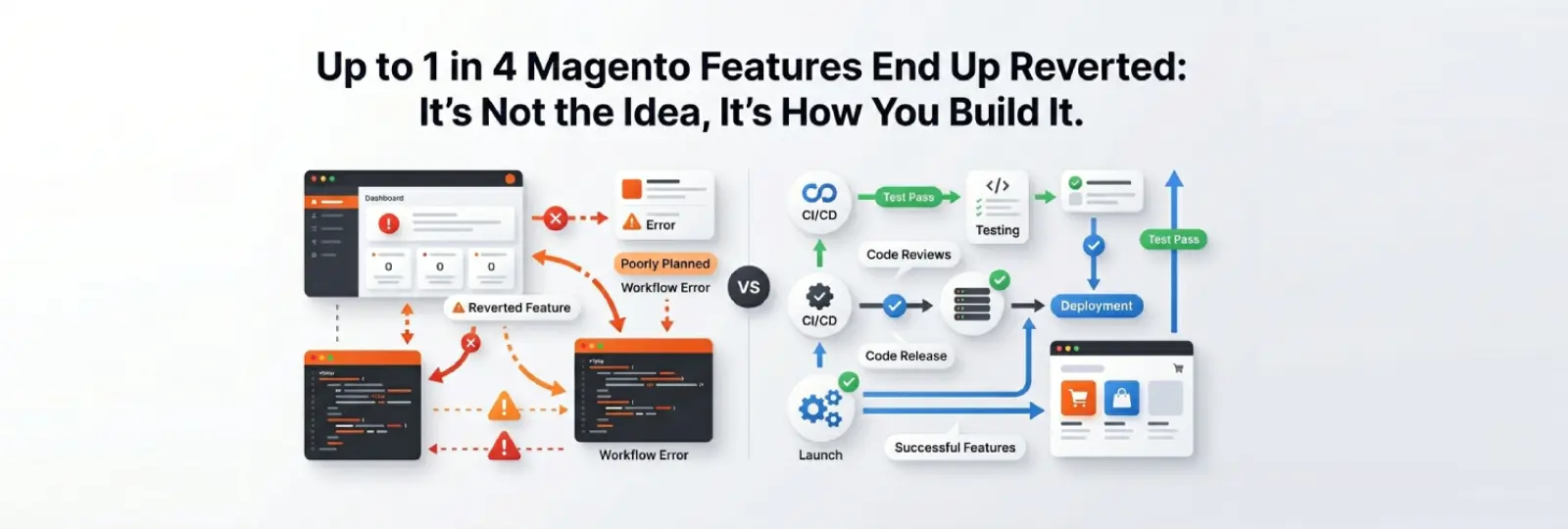
- Do we have CI/CD and rollback strategy?
Ensures safer, faster deployments with the ability to revert quickly if something goes wrong. - Zero downtime deployment?
Critical for maintaining uninterrupted user experience during releases.
SEO Health
- Crawl control for layered navigation?
Prevents unnecessary pages from being indexed, which can dilute SEO performance. - Any index bloat?
Too many low-value indexed pages can hurt overall search visibility.
Audits
- Do we have last 3 months audit reports?
Regular audits show how actively your store is being maintained and improved. - What improvements were made?
It’s not just about reports real value comes from implemented changes.