Skip to content

Magento Service Layer: Why It Saves You During Upgrades (Act Now, Save Money)
The Problem
Magento upgrades often become difficult not because of Magento itself, but because of how custom code is implemented over time.
In many projects, developers take shortcuts to deliver features quickly. Some of the most common patterns include:
- Direct use of models inside business logic
- Frequent use of load() and save() methods
- Tight coupling of custom code with Magento core classes
- Dependency on ObjectManager for object creation
While these approaches may work in the short term, they create a tightly coupled system. Over time, this leads to a fragile codebase where even a small Magento upgrade can break multiple functionalities.
What should have been a routine upgrade turns into a complex task involving debugging, refactoring, and extended QA cycles.
Why the Service Layer Helps
Magento provides Service Contracts (interfaces) to create a clear separation between your custom code and the core system. This is the foundation of the Magento Service Layer.
This service layer acts as a stable abstraction. Instead of interacting directly with models or internal classes, your code communicates through defined interfaces.
When you follow this approach:
- Your code depends on contracts (interfaces) rather than internal implementations
- Magento is free to change its internal structure without affecting your code
- Your custom modules become more stable and upgrade-friendly
This is especially important because Magento evolves internally across versions. If your code relies on internal classes, any change can break your implementation.But when you rely on the Magento Service Layer, Magento ensures backward compatibility at that level.
In simple terms, the service layer protects your code from internal changes and significantly reduces upgrade risk.
Example (Before vs After)
Before (Incorrect Approach)
$product = $this->_objectManager->create(\Magento\Catalog\Model\Product::class);
$product->load($id);
$product->setName(“New Name”);
$product->save();
In this approach:
- ObjectManager is used directly
- The model is accessed directly
- Business logic is tightly coupled with Magento internals
This makes the code harder to maintain, test, and upgrade.
After (Correct Approach)
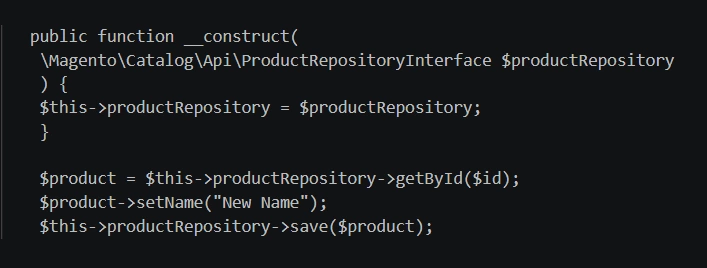
- Dependency Injection is used
- The code relies on a repository interface
- Magento handles the internal implementation
Both approaches achieve the same functional result, but the second approach is aligned with Magento’s architecture and is far more resilient during upgrades.
Cost of Ignoring This
Ignoring the magento service layer doesn’t just create technical issues it directly impacts time, cost, and business operations.
Some common consequences include:
- Increased number of breaking changes during upgrades
- Higher refactoring effort to fix compatibility issues
- Longer QA and testing cycles
- Greater risk of bugs reaching production
In real scenarios, this often results in upgrade efforts becoming two to three times more expensive and time-consuming than initially planned.
Other Challenges
Beyond upgrades, not following the magento service layer introduces additional long-term challenges:
- Difficult Unit Testing
- Poor API Compatibility
- Reduced Code Reusability
- Growing Technical Debt
Without interfaces, mocking dependencies becomes harder, making automated testing less effective
Integration with REST and GraphQL becomes limited when proper service contracts are not used
Tightly coupled code is harder to reuse across modules or projects
Small shortcuts accumulate over time, making the system harder to maintain and scale
These issues compound as the project grows, slowing down development and increasing maintenance costs.
Takeaway
To build a stable and upgrade-friendly Magento application:
- Always use interfaces provided by Magento
- Avoid direct use of ObjectManager in business logic
- Do not rely on load() and save() methods
- Follow Dependency Injection and repository patterns
- Align your implementation with Magento’s architectural guidelines
Most importantly, conduct regular code audits. This helps identify architectural issues early and prevents unexpected challenges during upgrades.
If Magento provides a service contract, it is there for a reason use it.
Final Thought
Magento is designed to be upgrade-friendly, but only when its architecture is respected.Businesses leveraging professional Magento development services are better equipped to follow these architectural standards effectively.
Most upgrade challenges are not caused by Magento itself they come from how the system is implemented.
Following the magento service layer is not just a best practice; it is a cost-saving strategy.
And one of the most important actions you can take is simple:
Make code audits a mandatory part of your development and maintenance plan.