Skip to content

How AI Is Transforming Retail eCommerce Experiences
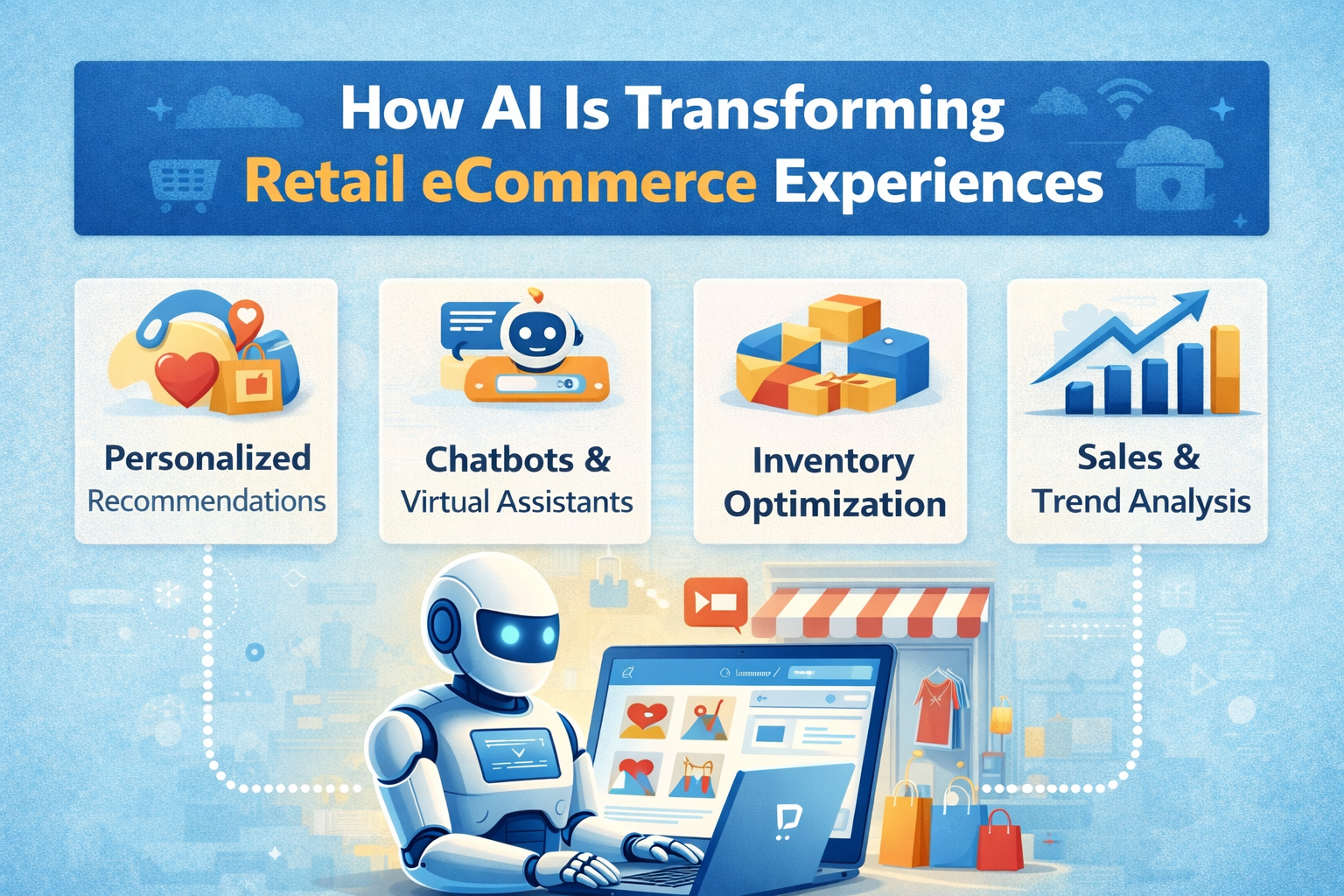
Over the past few decades, we have seen how Artificial Intelligence has transformed from a futuristic idea in technology to a norm around the globe. With ChatGPT and Gemini, it has engulfed people’s life decisions, and it’s like a personal assistant for everything. But that’s not all!
AI has infiltrated the B2B and B2C industries successfully. In retail, AI has revolutionised businesses by enabling them to tailor the customer experience to individual preferences.
Now, more than one-third of the shoppers expect that retailers should be offering more personalised shopping experiences. Moreover, Gen-Z shoppers also expect an increasingly high level of personalisation in all touchpoints. So, AI is something that you can’t really ignore if you want to be successful in the modern B2C market.
In this blog, we will be discussing how Artificial Intelligence has taken over retail and what AI trends you can follow to adopt it in your business. Let’s dive in!
Improved Demand Forecasting
One of the beneficial ways in which AI is helping the retail industry is by giving accurate demand forecasts. It’s no news that the retail market is surrounded by fierce competition from direct and indirect competitors. This makes it challenging to forecast evolving consumer preferences and demands. But with the help of AI, modern retailers are forecasting customer demand. Thus, it makes retailers more efficient in their purchasing decisions, allocation, stock replenishment, and related activities. When retailers are able to make informed decisions to manage their stock levels by the week, day, or even hour, they can make sure that they always have the products their customers are demanding. Not only this, but it will also help them to clear the storage of backup stock and lower the risk of overstocking or spoilage.
AI-Powered Personalization Engines
Do you ever see a shirt from your favorite brand and add it to your cart, but don’t click purchase? Yes, that information is saved, and then five minutes later, a suggested ad shows up when you are using Facebook. If you think that is a random occurrence, you are very mistaken. It’s basically AI in all its glory. AI algorithms track what you search, your past purchases, and the time spent on a certain product or service page. This helps them to make more deeply personal shopping experiences. For instance, eCommerce platforms now use AI-powered recommendation systems that adapt in real time. They show different products to different users based on their unique user behavior. It’s not about just user engagement. It’s AI smartly aiming to increase the average order value and customer retention on your ecommerce store.
Dynamic Pricing
Yes, it’s a fact that retailers have always adjusted prices. But with AI, pricing the products and services has become very dynamic and data-driven. AI can take different factors, such as competitor pricing, demand patterns, inventory levels, and even weather, into account to update the prices. Now, AI engines can update prices across various retail platforms and channels in real-time. The best part is that this is done without any human intervention. For companies that are using a retail app development company to create their ecommerce app, the modern feature of dynamic pricing is becoming a necessity.
Automated Customer Service
AI chatbots have taken over every ecommerce store and even the websites of small businesses and startups. AI-powered chatbots aren’t just responding to “Where’s my order?” questions. They’re fully integrated with CRMs and order management systems. This helps them provide updates on the order, suggest alternatives, process returns, and even upsell the customers during live chats. For retailers that offer brick-and-mortar stores alongside ecommerce, chatbots are now the norm for improving customer satisfaction and reducing costs. These AI-powered chatbots are available 24/7 and can handle hundreds of customer interactions simultaneously.
Visual and Voice Search
Have you ever seen a piece of furniture online that you really liked and thought that you could find something similar just by taking a screenshot? That’s exactly what visual search does. You just have to upload a picture of the product, and voila, it instantly shows you matching products. It’s especially popular in fashion and home décor. Because people love finding items that fit their unique style. And it’s not just limited to photos. Voice search is also becoming a favorite AI trend. Do you need to reorder the weekly groceries or restock office supplies? Just say it aloud to your grocery app on your smartphone, and the system finds it for you. AI powers both of these tools to make it easy for customers to find the right products faster and easier.
Personalised Shopping Experiences
In today’s time, people spend a huge chunk of their day on their screens. This means so many customers see a brand online on their socials, reviews, or website long before they ever visit its ecommerce app. So, targeted banner ads, social media promotions, and other marketing campaigns help shape how people think about a brand from the get-go. These seemingly small first impressions influence how customers will interact with the retail store later. It also affects how they feel about their overall shopping experience. By using insights from customer behavior and past interactions, brands can create marketing that feels relevant and personal. They can also avoid using ads that feel overwhelming or unnecessary.
Key Takeaway
Using AI in your retail format is challenging for sure. But the rewards you reap for finding the right AI trends mix for your business will make the customer interactions and experiences at your brand truly memorable. So, whether you’re making the first step to include AI in your retail business or you’re looking to optimise existing tools and processes, we hope this guide has helped you make greater sense of the topic.