Skip to content

Unmasking the Silent Killers: A Deep Dive into Magento Code Audits
Magento, a powerful and flexible e-commerce platform, offers unparalleled customization. With strong Magento support and a vast ecosystem, businesses can scale efficiently. However, this very flexibility can become a double-edged sword. Without careful development practices and continuous Magento optimization, a Magento store can quickly become burdened with performance bottlenecks, security vulnerabilities, and maintenance nightmares. This is where a comprehensive Magento code audit becomes not just beneficial, but absolutely critical.
A code audit acts as a diagnostic tool, meticulously examining the underlying codebase to identify issues that can range from minor inefficiencies to critical, store-crushing flaws. It’s about unmasking the “silent killers” those hidden problems that slowly erode performance, frustrate customers, and ultimately impact your bottom line. Proper Magento support combined with strategic Magento optimization ensure these issues are detected before they escalate.
Let’s dissect some of the most common and impactful issues uncovered during a Magento code audit, understanding their implications and how to address them.
Critical: Model Loading Inside Loops – The N+1 Query Avalanche
Imagine a postal worker delivering one letter at a time to 100 different houses on a street. That’s essentially what “model loading inside a loop” does to your database. This critical issue occurs when an entity (like a product, customer, or order) is loaded individually within a loop.
The Problem: Each time the loop iterates, a separate query is sent to the database. If your loop runs 100 times, you’re looking at 100 individual queries (N queries) on top of the initial query to get the loop data (+1 query). This “N+1 query problem” quickly escalates into a massive database load, dramatically slowing down page load times and taxing server resources. Without proper Magento optimization, it’s like a tiny drip that eventually floods the entire house.
Visualizing the Impact:
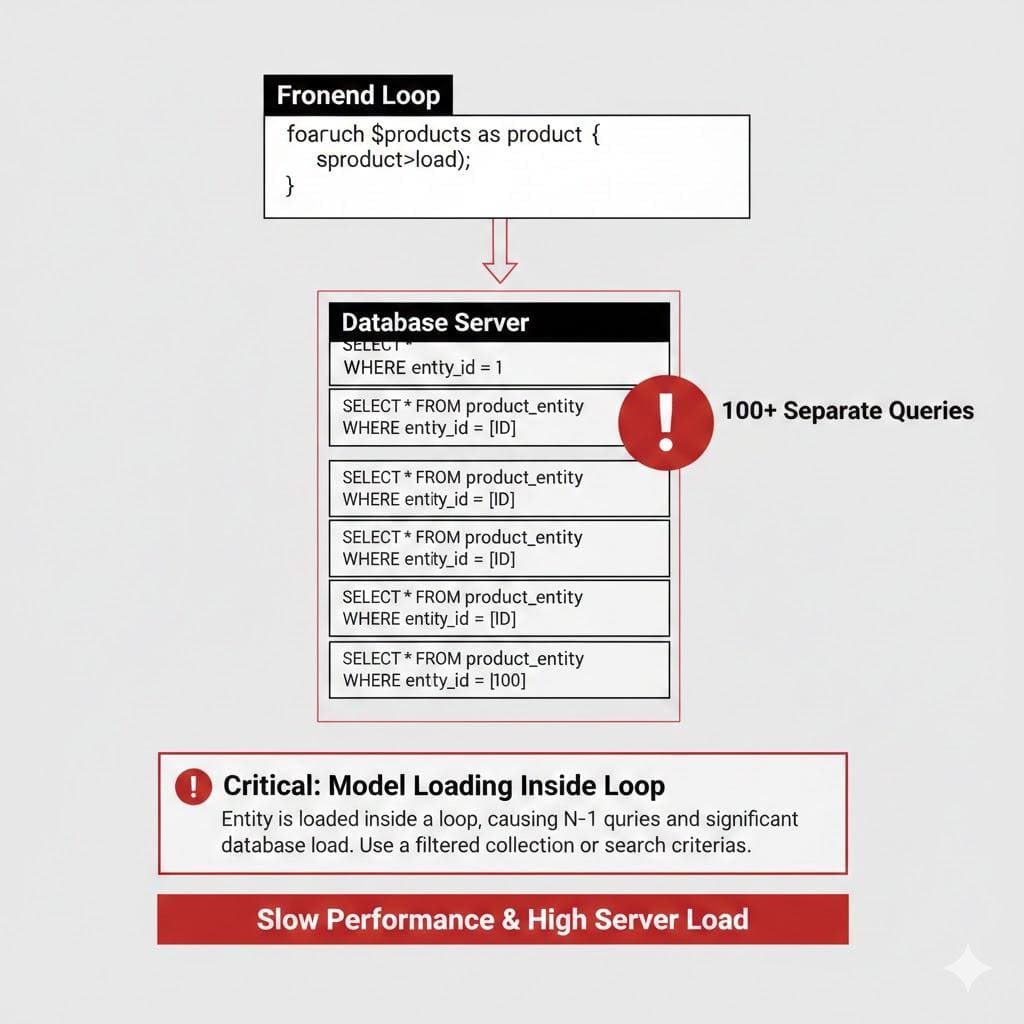
The Solution: The key is to fetch all necessary data in a single, optimized query before the loop begins. This can be achieved by using filtered collections or Magento’s Search Criteria API. Instead of loading models one by one, you load a collection of models that already contain the required data, effectively reducing 101 queries to just one or two. Strong Magento support can help developers implement these best practices efficiently.
Critical: Missing or Incorrect Database Indexes – The Full Table Scan Nightmare
Imagine trying to find a specific book in a library that has no catalog or organization. You’d have to literally scan every single shelf and every single book until you found it. This is analogous to a “full table scan” in a database.
The Problem: When queries filter or join on columns that lack appropriate database indexes, the database engine is forced to scan every single row in the table to find the relevant data. This is incredibly inefficient, especially for large tables, and significantly degrades query performance. Without consistent Magento optimization, this becomes like a traffic jam on a highway but for your data.
Visualizing the Impact:
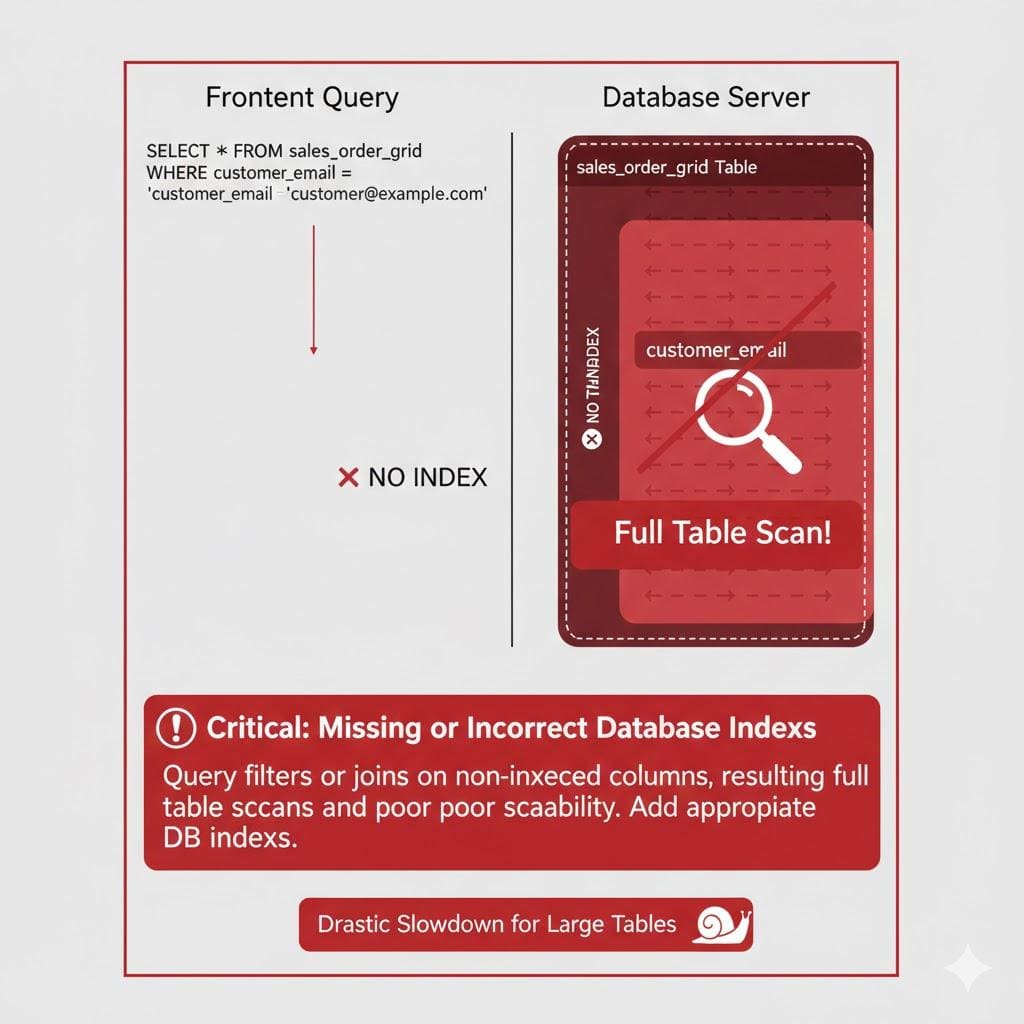
The Solution: Database indexes are like the library’s catalog. They create a sorted shortcut to specific data, allowing the database to quickly locate rows without scanning the entire table. Identifying frequently queried columns and adding appropriate indexes (e.g., on product SKUs, customer emails, order IDs) can dramatically improve query speeds and overall scalability. Expert Magento support ensure indexing strategies are properly implemented and maintained.
High: Cache-Unsafe Block Logic – The Cache Killer
Magento’s Full Page Cache (FPC) is a cornerstone of its performance architecture and a key component of successful Magento optimization. It saves fully rendered pages, serving them almost instantly to subsequent visitors. However, incorrect logic can inadvertently bypass or invalidate this crucial caching mechanism.
The Problem: When dynamic or customer-specific data (like a “Welcome, [Customer Name]!” message or a personalized cart summary) is rendered directly within a cached block, Magento’s FPC is either prevented from caching the page at all, or it caches a version that is only valid for a single user. This leads to the cache being constantly bypassed or regenerated, effectively negating its benefits. The “Time To First Byte” (TTFB) increases significantly, resulting in a slow user experience.
Visualizing the Impact:
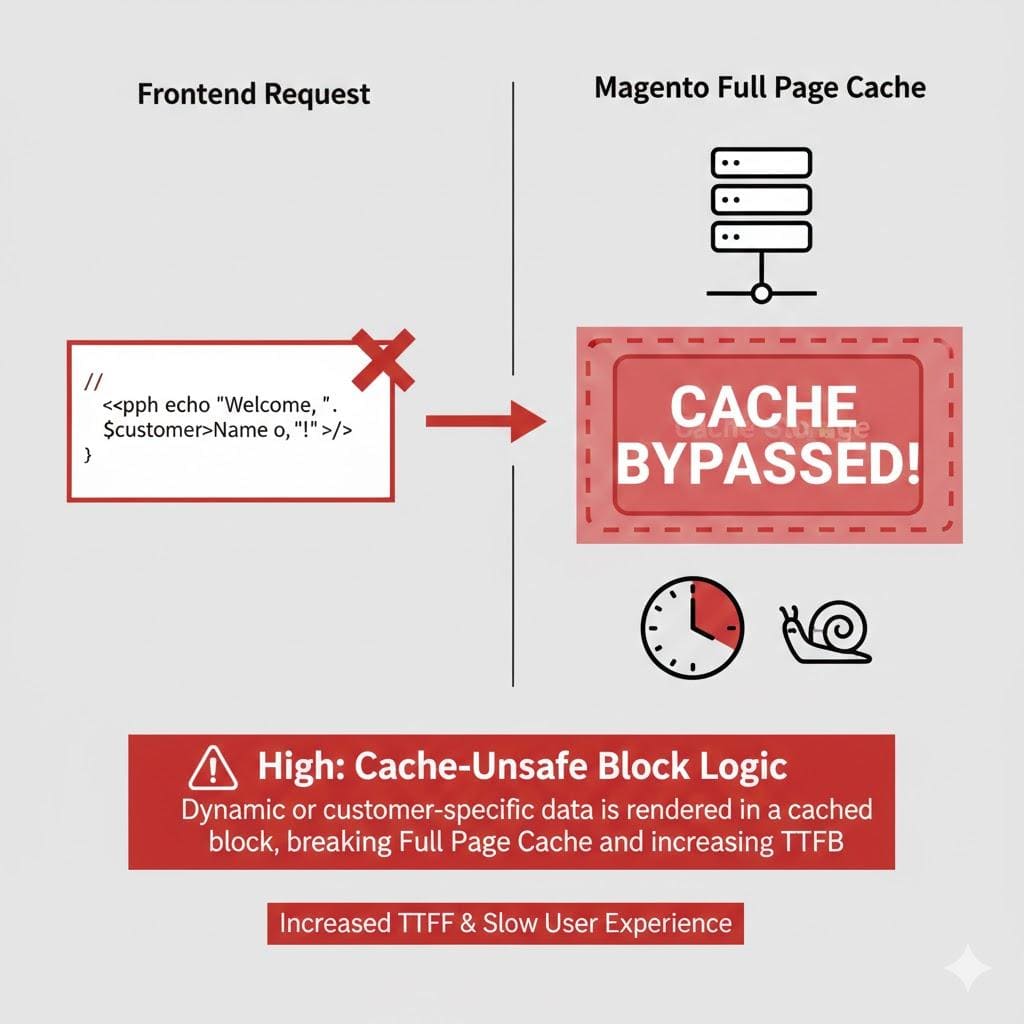
The Solution: Isolate dynamic content. Magento provides mechanisms like “holes” or AJAX-loaded blocks to handle personalized content. The main page can be cached, and the dynamic parts are then loaded asynchronously after the page has rendered, ensuring the FPC remains effective. Reliable Magento support can guide proper cache architecture implementation.
High: Heavy Logic Executed During Page Render – The User Experience Killer
Users expect instant gratification when browsing online. If your website feels sluggish, they’ll abandon their carts and leave. Heavy logic executed during page render is a primary culprit that signals poor Magento optimization.
The Problem: This issue arises when complex calculations, third-party API calls, or extensive data processing are performed synchronously during the initial page load. Every millisecond spent on these operations delays the rendering of the page, leading to a frustratingly slow user experience.
Visualizing the Impact:
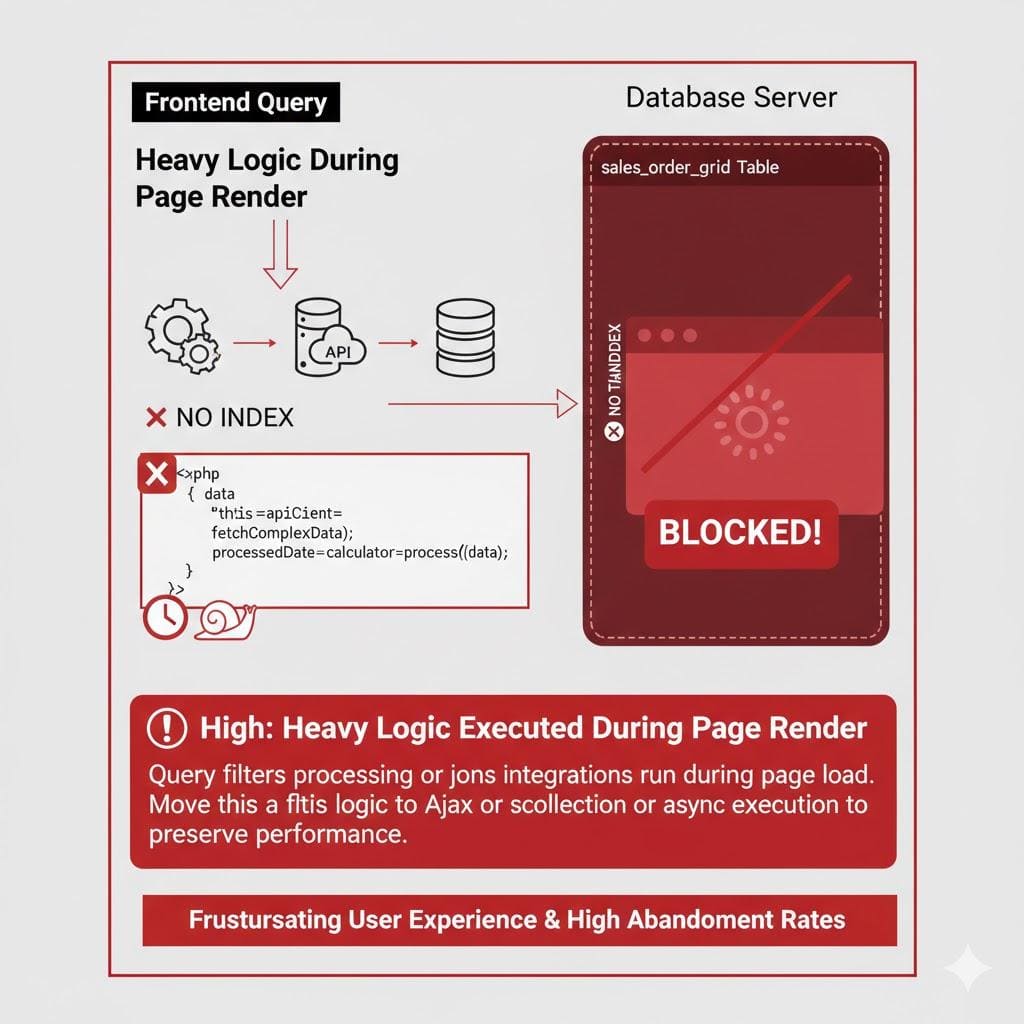
The Solution: Defer this heavy logic. Utilize AJAX to load dynamic components after the initial page renders. For non-critical background tasks, leverage asynchronous processing, message queues (like RabbitMQ), or cron jobs. This approach, supported by advanced Magento support, allows the page to load quickly while heavier tasks complete in the background.
Medium: Heavy Observer or Around-Plugin Usage – The System-Wide Drag
Magento’s event-driven architecture, powered by observers and plugins, offers powerful ways to extend functionality without modifying core code. With proper Magento support, this flexibility becomes a strength. However, misuse can introduce widespread performance issues.
The Problem: Observers and around-plugins execute code whenever a specific event is dispatched or a method is called. If these components contain heavy business logic, database operations, or external API calls, they can significantly impact the performance of every request that triggers them. Without disciplined Magento optimization, this becomes a system-wide drag on performance.
Visualizing the Impact:
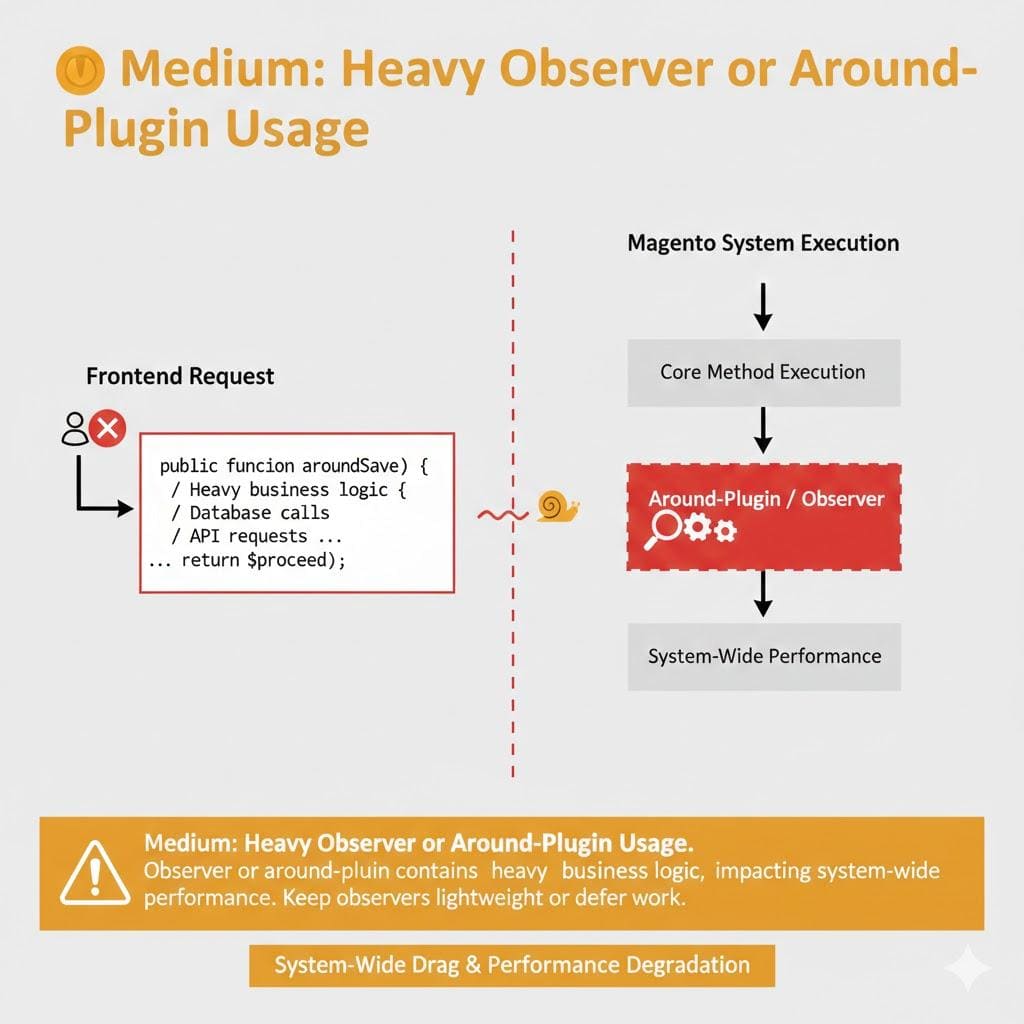
The Solution: Keep observers and plugins as lightweight as possible. Their primary role should be to trigger further actions, not to perform the actions themselves. If heavy logic is required, defer it to asynchronous processes or dedicated services that can be called efficiently. Careful implementation through professional Magento support ensures stability and maintainability.
The Value of a Proactive Approach
Ignoring these code issues is akin to ignoring warning lights on your car’s dashboard. Eventually, a minor problem can escalate into a major breakdown. A professional Magento code audit provides a detailed roadmap for Magento optimization, ensuring your store is not just functional, but performs at its peak.
Investing in a regular code audit offers numerous benefits:
- Improved Performance: Faster page loads lead to happier customers and higher conversion rates.
- Enhanced Scalability: Your store can handle increased traffic and product catalogs without buckling under pressure.
- Reduced Hosting Costs: Optimized code uses fewer server resources.
- Better Maintainability: Clean, efficient code is easier for developers to work with, reducing future development costs and time.
- Increased Security: Audits can identify and mitigate potential security vulnerabilities.
- Future-Proofing: Ensures your store is built on a solid foundation, ready for future Magento updates and new features.
Don’t wait for your Magento store to grind to a halt. Proactive code auditing, combined with strategic Magento optimization and reliable Magento support, is an essential practice for any serious e-commerce business transforming potential liabilities into powerful assets that drive growth and customer satisfaction.