Skip to content

Table of Contents
- Introduction
- Developers Are Rising, Not Exiting as AI Is Enhancing Developers
- AI Is Now a Building Block for Developers
- The AI Reality: Partnership Rather than Replacement
- Why Human Developers Are Still Needed Instead of AI
- How AI Uplifts Developer Productivity
- More Roles, Not Less
- What Lies Ahead for Junior Developers
- What This Means for Your Career (and Your Team)
AI Is Enhancing Developers, Not Replacing Them: The Real Future of Software
Introduction
If there’s one thing ever so clearly in doubt in tech right now, it’s the role of software developers in the age of artificial intelligence (AI). We’re seeing both hyperbolic headlines about how developers are finished and intelligent analyses on the future of work. One thing that’s frequently absent from this conversation, especially on LinkedIn, is a realistic view based on what already is: in 2025–2026, AI is enhancing Developers by improving developer ability, not replacing them.
In this article I will explain why developers will continue to be necessary, how AI is changing what that means by changing what their roles mean (rather than taking jobs), and what the latest industry trends such as Google’s AI evolution say about the future of software engineering
1. Developers Are Rising, Not Exiting as AI Is Enhancing Developers
The most startling late 2025 industry survey reveals 65% of senior developers due to have their roles redefined by AI in 2026, moving from monotonous coding to system architecture, strategy, and AI-integration. Instead of taking a backseat to developers, higher-value tasks were being taken on by them, showing how AI Is Enhancing Developers. Designing technical solutions rather than typing boilerplate code. Supervising entire pipelines and moderating AI-generated outputs too, taking on essential functions like security, performance tuning, and inter-system connectivity. This underscores a larger shift work that can be automated, even if it’s not the best work.
2. AI Is Now a Building Block for Developers
Internal and public reports suggest that a substantial percentage of new code in the major tech companies is powered by AI is Enhancing Developers ,but developers continue to review, polish and shepherd that output. At Google, more than a quarter of new code is AI-generated and then reviewed by human engineers. This isn’t code “written on its own” it’s collaboration: Humans evaluate the proposals from AI. AI generates human design. AI is for automating scaffolding, humans for solving edge cases. AI is not supplanting developers, it’s increasing their output.
3.The AI Reality: Partnership Rather than Replacement
Industry leaders offer nuanced perspectives:
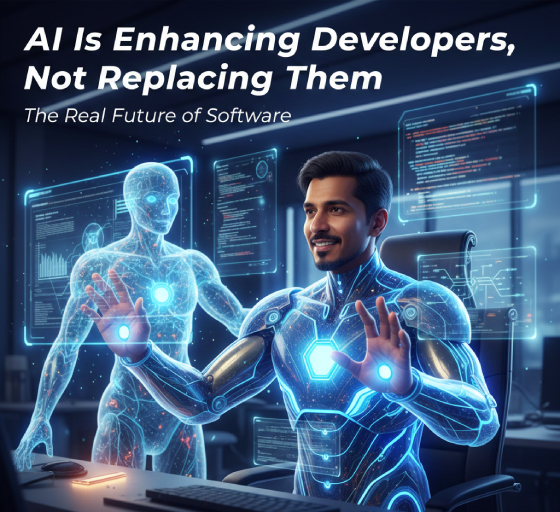
Google executives have likened AI to an Iron Man suit for developers making them stronger without replacing the pilot.
GitHub’s chief executive officer has said the most intelligent companies will hire more engineers, not fewer, as they use AI to build faster and smarter products.
The clear pattern? AI augments productivity while developers retain authority, context, and control.
4.Why Human Developers Are Still Needed Instead of AI
The technical and practical reasons for why it will still be a long time before AI replaces software developers include the following:
🔹 Context and Domain Knowledge
AI does not have a deep knowledge of complex business rules or regulatory constraints, nor can it incorporate domain-specific criterion. Developers bake that knowledge into products and services one of the reasons AI is enhancing Developers, not replacing them.
🔹 Security and Compliance
The code has to be safe, private, and compliant. Code produced by AI needs to be audited by humans fairly thoroughly especially for vulnerabilities and edge cases, which are notoriously difficult for automated systems to identify.
🔹 System Design and Architecture
While AI can create stand-alone modules, genuine software engineering is system design including long-term thinking about scalability, reliability, and future modification. Those are not code-and-compile tasks; they’re activities that rely on the human element.
And work in academia has found that AI-created code has a certain distinct style, in some cases more repetitive or more prone to certain errors, such that oversight is needed for the quality of the code.
5. How AI Uplifts Developer Productivity
The change we’re seeing is a stir augment not replaced. Having said that, here’s how AI is improving the productivity of software engineers:
➤ Accelerated coding and prototyping
AI tools now create entire feature branches, test suites, and documentation saving time on boilerplate work.
➤ Smarter debugging and code quality improvements
AI agents such as Jules by Google are intended to repair buggy code, propose modifications and create pull requests so developers can concentrate on architecture and logic.
➤ Unified AI in day-to-day tools
Now most developers use AI-driven assistance in the IDE, including intelligent code completion, context aware code suggestions greatly increasing velocity and reducing drudgery.
The result? Developers are strategists and validators, not typists,because AI Is Enhancing Developers.
6. More Roles, Not Less
With AI transforming workflows, these are just a few of the new roles taking shape. AI-assisted development engineers, specialized developers who understand prompt engineering and AI workflows.
AI integration architects : the designers of how AI elements communicate with legacy platforms.
Model governance and ethics engineers : promoting responsible AI use.
Senior practitioners understand that development means guiding AI rather than being pushed to the sidelines which is a big part of why the demand for experienced engineers is still so high.
7 . What Lies Ahead for Junior Developers
Anxiety about junior roles is real but it reflects role redefinition, not role obsolescence. The simple tasks may be lessened, but the learning for the basics is important.
Junior engineers, too, need a pretty solid background in algorithms, building stuff, architecture, and debugging if they’re going to be meaningful teachers of AI.
Those organizations that do invest in upskilling will be best positioned to harness AI and grow talent.
In one sense, AI lifts the curtain but it doesn’t pull away from the stage.
8. What This Means for Your Career (and Your Team)
So if you’re a dev, tech lead, or recruiter thinking about AI and jobs, here’s the main takeaway: AI will change the way we work, but not why we work.
Focus on:
Up-skilling Learn how to live with and direct AI tools with accuracy from prompt engineering to embedded workflows.
Higher Order Thinking System design, architecture, ethics, scalability. These human superpowers never go out of style.
Human-AI Collaboration Create processes in which repetitive work is done by AI and you add context, judgement and supervision. This is not a world where people are no longer needed; it’s a world where people are made stronger.