Skip to content

Table of Contents
- Introduction
- What Is Shopify App Development?
- Why Shopify App Development Is Important
- Types of Shopify Apps
- Shopify App Development Architecture
- Shopify APIs Used in App Development
- Shopify App Development Process
- Common Use Cases for Shopify App Development
- Shopify App Development and Performance
- Security in Shopify App Development
- Challenges in Shopify App Development
- Shopify App Development for Scaling Businesses
- When Should You Invest in Shopify App Development?
- Future of Shopify App Development
Shopify App Development: A Practical Guide to Building Scalable, Custom Shopify Solutions
Shopify Application Development has become one of the most critical areas of growth in the Shopify ecosystem. As businesses scale, their requirements often go beyond what themes and off-the-shelf apps can provide. This is where custom Shopify apps play a vital role.
While Shopify offers thousands of apps in its App Store, no two businesses operate in exactly the same way. Custom workflows, unique pricing logic, integrations with external systems, and performance requirements often demand tailored solutions. Shopify App Development enables merchants to extend Shopify’s core functionality and build systems that fit their business instead of forcing their business to fit the platform.
In this article, we’ll explore what Shopify App Development really means, why it matters, how it works, and when businesses should invest in custom Shopify apps.
What Is Shopify App Development?
Shopify Application Development is the process of creating applications that extend or modify the functionality of a Shopify store. These apps can be private (custom-built for a single store), custom apps for specific businesses, or public apps listed on the Shopify App Store.
A Shopify app can:
- Automate business workflows
- Integrate third-party services
- Modify checkout or cart behavior (within Shopify limits)
- Manage products, orders, customers, or inventory
- Add advanced logic that themes alone cannot handle
Unlike theme development, which focuses on the storefront UI, Shopify App Development focuses on business logic, automation, and integrations.

Why Shopify App Development Is Important
As a Shopify store grows, limitations start to appear. Apps bridge the gap between Shopify’s standard features and real-world business needs.
1. Custom Business Logic
Every business has unique rules:
- Custom pricing
- Conditional discounts
- Order validation
- Inventory logic
- Shipping rules
Shopify Application Development allows these rules to be implemented cleanly and reliably.
2. Reduced App Dependency
Many stores install dozens of apps to achieve simple goals. This leads to:
- Slower store speed
- Script conflicts
- Higher monthly costs
Custom apps often replace multiple third-party apps with a single optimized solution.
3. Better Performance and Stability
Well-built Shopify apps:
- Load only when needed
- Avoid unnecessary frontend scripts
- Improve store performance
This is especially important for high-traffic stores.
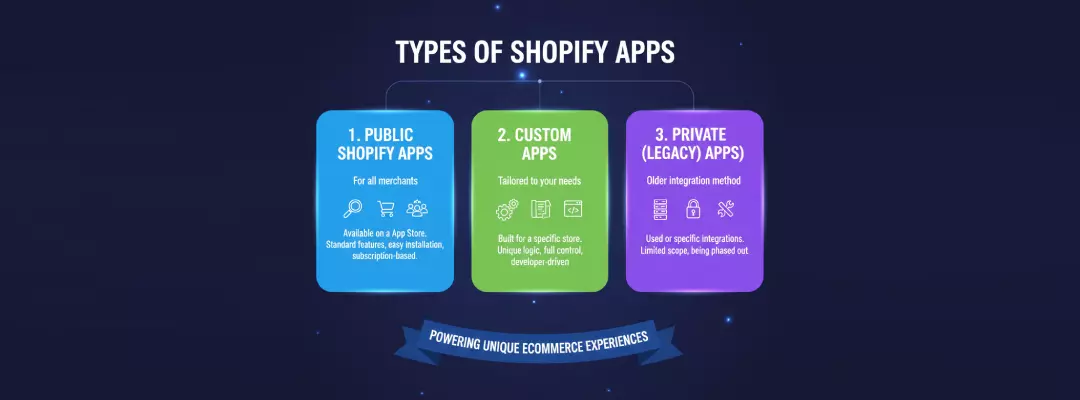
Types of Shopify Apps
Understanding app types is key in Shopify App Development.
1. Public Shopify Apps
- Listed on the Shopify App Store
- Built for multiple merchants
- Must follow Shopify’s review guidelines
- Designed to be scalable and configurable
2. Custom Apps
- Built for a specific business
- Not publicly listed
- Ideal for unique workflows or integrations
3. Private (Legacy) Apps
- Older app type (being phased out)
- Replaced by custom apps
- Used mainly for internal integrations
Most modern Shopify App Development focuses on custom apps and public apps.
Shopify App Development Architecture
A Shopify application typically consists of two parts:
1. Admin Application
The backend handles:
- Business logic
- API communication
- Data processing
- Authentication
- Webhooks
Common backend technologies include:
- Node.js
- Ruby on Rails
- Rust
- Python
- PHP
2. Shopify Integration Layer
This layer connects the app with Shopify using:
- Shopify Admin API
- Storefront API
- Webhooks
- Shopify Functions
Together, these components allow apps to interact with Shopify data securely.
Shopify APIs Used in App Development
Shopify App Development relies heavily on APIs.
Shopify Admin API
Used to manage:
- Products
- Orders
- Customers
- Discounts
- Metafields
Storefront API
Used for:
- Headless storefronts
- Custom frontend experiences
- Product and cart data access
Webhooks
Webhooks notify apps when events occur, such as:
- New orders
- Product updates
- Inventory changes
This allows real-time automation.
Shopify App Development Process (Step-by-Step)
Step 1: Requirement Discovery
This phase defines:
- Business problems
- Workflow gaps
- Required integrations
- Performance expectations
Clear requirements prevent costly rework later.
Step 2: App Architecture Planning
Developers decide:
- Backend technology
- API usage
- Data flow
- Security model
Good architecture ensures scalability.
Step 3: Authentication & Permissions
Shopify apps use OAuth for secure authentication.
Apps must request only necessary permissions to:
- Protect merchant data
- Pass Shopify compliance reviews
Step 4: Core Feature Development
This includes:
- Business logic
- API calls
- Automation rules
- Admin UI (if needed)
Step 5: Frontend Integration (Optional)
Some apps add:
- Admin dashboards
- Storefront widgets
- Checkout or cart logic (via extensions)
Step 6: Testing & QA
Testing includes:
- API reliability
- Edge cases
- Permission handling
- Load testing
Step 7: Deployment & Maintenance
Once live, apps require:
- Monitoring
- Bug fixes
- API updates
- Shopify version compatibility
Common Use Cases for Shopify App Development
1. ERP & CRM Integrations
Custom apps connect Shopify with:
- ERP systems
- Accounting tools
- CRM platforms
This ensures data consistency.
2. Advanced Pricing Logic
Apps handle:
- B2B pricing
- Tiered discounts
- Region-based pricing
3. Custom Checkout Rules (Shopify Plus)
Using checkout extensibility, apps can:
- Validate orders
- Add custom fields
- Apply business rules
4. Inventory & Order Automation
Apps automate:
- Stock syncing
- Fulfillment routing
- Order tagging
Shopify App Development and Performance
Poorly built apps can slow down stores. Good Shopify App Development focuses on:
- Backend processing instead of frontend scripts
- Conditional loading
- Efficient API calls
- Minimal JavaScript injection
Performance-first development is essential for SEO and conversions.
Security in Shopify App Development
Security is a major responsibility.
Best practices include:
- Secure API token storage
- Webhook verification
- Role-based permissions
- Data encryption
- Regular audits
Shopify enforces strict app security standards, especially for public apps.
Challenges in Shopify App Development
1. API Rate Limits
Apps must manage API usage efficiently to avoid throttling.
2. Shopify Platform Changes
Shopify evolves rapidly. Apps must stay compatible with:
- API version updates
- Deprecations
- New app standards
3. Multi-Store Compatibility
Public apps must work across:
- Different themes
- Different store setups
- Different business rules
Shopify App Development for Scaling Businesses
As businesses grow, Shopify App Development becomes less of an option and more of a necessity. Custom apps enable:
- Faster operations
- Better data control
- Lower long-term costs
- Competitive advantages
Many high-revenue Shopify stores rely heavily on custom apps behind the scenes.
When Should You Invest in Shopify App Development?
You should consider it when:
- Apps are slowing your store
- Business logic is complex
- Manual processes consume time
- Integrations are unreliable
- You are scaling rapidly
Custom Shopify apps are long-term assets, not short-term expenses.
Future of Shopify App Development
Shopify App Development is moving toward:
- Shopify Functions replacing scripts
- More extensibility
- Better performance standards
- Headless and composable commerce
Developers who understand both Shopify’s ecosystem and real business needs will be in high demand.
Final Thoughts
Shopify App Development is about solving real problems, not just adding features. A well built Shopify app improves efficiency, performance, and scalability while reducing dependency on multiple third-party tools.
For businesses serious about growth, investing in thoughtful Shopify App Development is one of the most powerful decisions they can make.