Skip to content

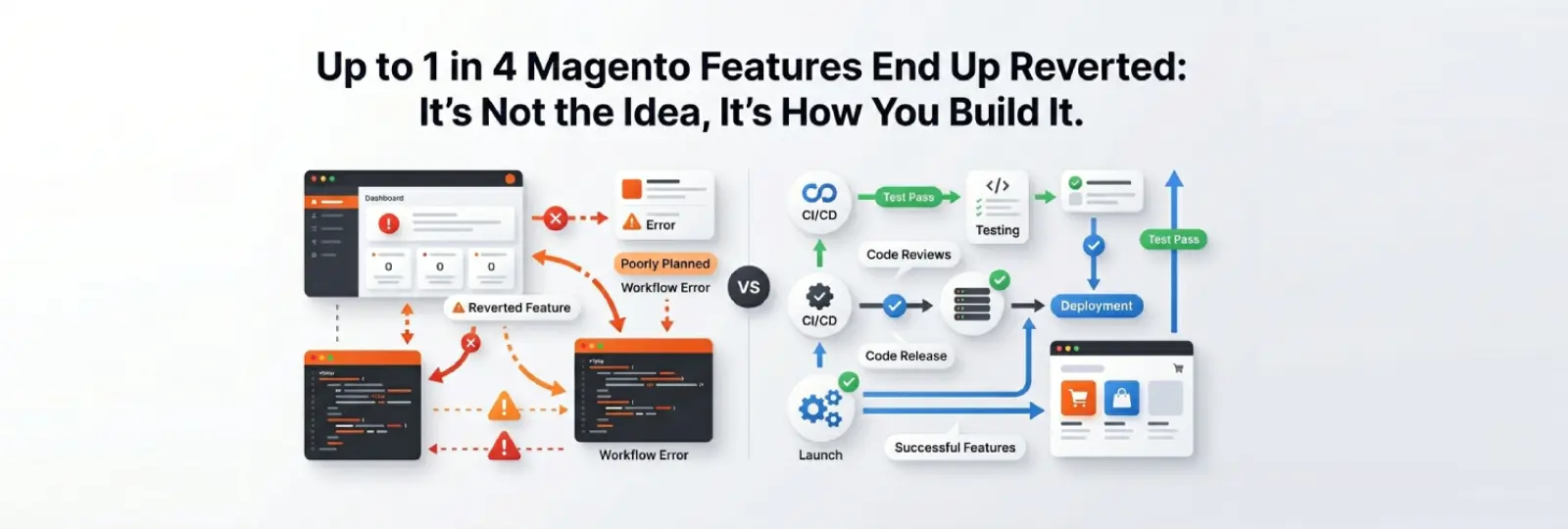
Up to 1 in 4 Magento Features End Up Reverted: It’s Not the Idea, It’s How You Build It
Feature rollbacks in Magento are rarely the result of bad ideas. In most cases, the intent behind the feature is valid, sometimes even valuable. The real issue lies in how the feature is designed, integrated, and scaled within the Magento ecosystem. What initially looks like a useful enhancement often turns into a performance bottleneck, a maintenance burden, or a source of instability. Over time, the cost of keeping it alive outweighs its benefits, and the feature gets rolled back.
This is not a development problem alone, it’s a decision-making problem.
What a Manager Should Ask
Before a single line of code is written, the right questions can prevent months of rework.
Start with clarity on purpose
- Is this a business-critical feature or simply a nice-to-have?
- Does it directly impact revenue, conversion, or operational efficiency?
Many Magento features get approved because they appear useful, not because they solve a measurable business problem. That distinction becomes critical as the platform scales.
Evaluate existing alternatives
- Can the requirement be solved through native Magento configuration?
- Is there an existing Magento architectural pattern that already addresses it?
Magento is an opinionated framework with established patterns for handling catalog behavior, pricing logic, checkout customization, caching, and indexing. Ignoring these patterns and jumping directly into custom development often introduces avoidable complexity.
Make the right architectural decision
Should this requirement be handled by:
- Building a fully custom solution
- Extending an existing module
- Integrating a third-party extension
Each approach comes with trade-offs. Choosing the wrong implementation path may solve the immediate requirement while creating long-term maintenance challenges.
Think beyond initial delivery
Ask the questions that often get overlooked:
- What is the upgrade impact?
- Who will own long-term maintenance?
- How will this interact with pricing, checkout, indexing, and cache behavior?
Magento features rarely operate in isolation. Even a small customization can affect multiple parts of the platform, and a minor architectural misstep can create system-wide ripple effects later.
Cost of Ownership
One of the biggest misconceptions in Magento development is underestimating the true cost of a feature.
The initial build typically accounts for only 30–40% of the total effort. The remaining 60–70% comes later through testing, bug fixes, compatibility updates, performance tuning, and ongoing support.
While these numbers can vary by project, the pattern remains consistent: the majority of effort happens after the first release.
This is where most teams get caught off guard.
Custom development may seem cost-effective upfront because it avoids licensing fees. However, it requires strong internal ownership. Without clear accountability, documentation, and coding standards, custom code can quickly become difficult to maintain and risky to modify.
On the other hand, third-party modules reduce initial development time but introduce recurring costs and additional complexity. They bring their own dependencies, release cycles, and constraints, which may not always align with your system or business requirements.
Neither approach is inherently right or wrong. The real risk comes from making a decision without fully understanding the long-term maintenance, upgrade impact, and operational overhead involved.
Impact on Cache & Resources
Performance impact is one of the most overlooked aspects during feature planning.
Magento relies heavily on caching mechanisms, particularly full-page cache (FPC). A poorly implemented feature can reduce cache effectiveness or introduce unnecessary cache invalidations, leading to performance degradation across the site.
Key questions to ask:
- Does the feature introduce dynamic or user-specific content on otherwise cacheable pages?
- Will it reduce the full-page cache hit ratio?
- Does it trigger frequent or unnecessary cache invalidation?
Not all dynamic content is a problem. Magento supports private content and AJAX-based rendering, but handling it incorrectly can force pages to bypass caching entirely.
Even small changes can have a disproportionate impact.
Beyond caching, consider resource usage
- Will this feature increase database queries per request?
- Does it introduce observers or plugins that execute on high-frequency events?
- Does it affect indexing processes or increase re-index frequency?
Features that appear lightweight in isolation can create significant overhead when combined with other customization and modules.
Over time, this leads to slower page load times, increased server resource consumption, and a degraded user experience.
Common Mistakes
Most feature rollbacks can be traced back to a few recurring mistakes:
1. Building without understanding Magento’s cache layers
Developers often implement functionality without considering how it interacts with full-page cache (FPC), block cache, and private content. This can lead to unnecessary cache invalidations or pages becoming fully dynamic where caching should be preserved.
2. Stacking multiple modules solving similar problems
It’s common to see multiple extensions addressing overlapping use cases. This introduces conflicts, duplicated logic, and unpredictable behavior, especially when modules modify the same core functionality.
3. Ignoring upgrade compatibility and dependency conflicts
A feature that works today may fail during a Magento upgrade. Poor dependency management, version mismatches, and tightly coupled implementations make upgrades risky, time-consuming, and error-prone.
4. Over-engineering simple use cases
Not every requirement needs a complex architectural solution. Over-engineering increases development time, introduces unnecessary abstractions, and makes future maintenance more difficult than necessary.
5. Overuse of observers and plugins in high-frequency flows
Adding observers or plugins (interceptors) on frequently triggered events such as cart updates, checkout steps, or product loads can introduce hidden performance overhead and make system behavior harder to trace and debug, contributing to Magento Feature Rollbacks.
Pros & Cons of Different Approaches
Every implementation approach has its strengths and trade-offs. Choosing the right one depends on the specific requirement, system complexity, and long-term maintenance strategy.
Custom Development
Pros:
- Tailored exactly to your business requirements
- Can be highly performant when aligned with Magento architecture
- Full control over logic, data flow, and extensibility
Cons:
- Requires strong development standards and architectural discipline
- Depends heavily on internal ownership and documentation
- Poorly implemented custom code can become difficult to maintain and risky to extend
Third-Party Modules
Pros:
- Faster time to implementation
- Pre-built and tested functionality
- Reduces initial development effort
Cons:
- May introduce unnecessary features or overhead
- Adds external dependencies and version compatibility considerations
- Limited flexibility if the module does not fully align with your business logic
Well-maintained modules can be stable and reliable, but they still need to be evaluated carefully for long-term fit.
Extending Existing Modules
Pros:
- Quick way to adapt or enhance existing functionality
- Avoids rebuilding features that already exist
Cons:
- Can become tightly coupled to the base module’s internal implementation
- More fragile during upgrades if the underlying module changes
- Requires careful design to avoid conflicts with future updates
The Real Takeaway
Most reverted features are not failures of ideas—they are failures of implementation.
The role of a manager is not just to approve features based on business requirements, but to ensure those features are built in a way that can sustain:
- Scale
- System complexity
- Magento upgrades
- Performance pressure
A feature that works in isolation but fails under real-world conditions is not a successful feature.
Strong decision-making and solid implementation go hand in hand. One without the other will eventually lead to failure.
Final Thought
If you are planning a Magento feature, pause before jumping into development.
Evaluate:
- Whether the feature is truly necessary
- The right way to implement it within Magento’s architecture
- Its long-term cost and impact on the system
Because once a feature is built, the real work begins.
And if the foundation isn’t strong, rollback isn’t just possible—it becomes likely.